
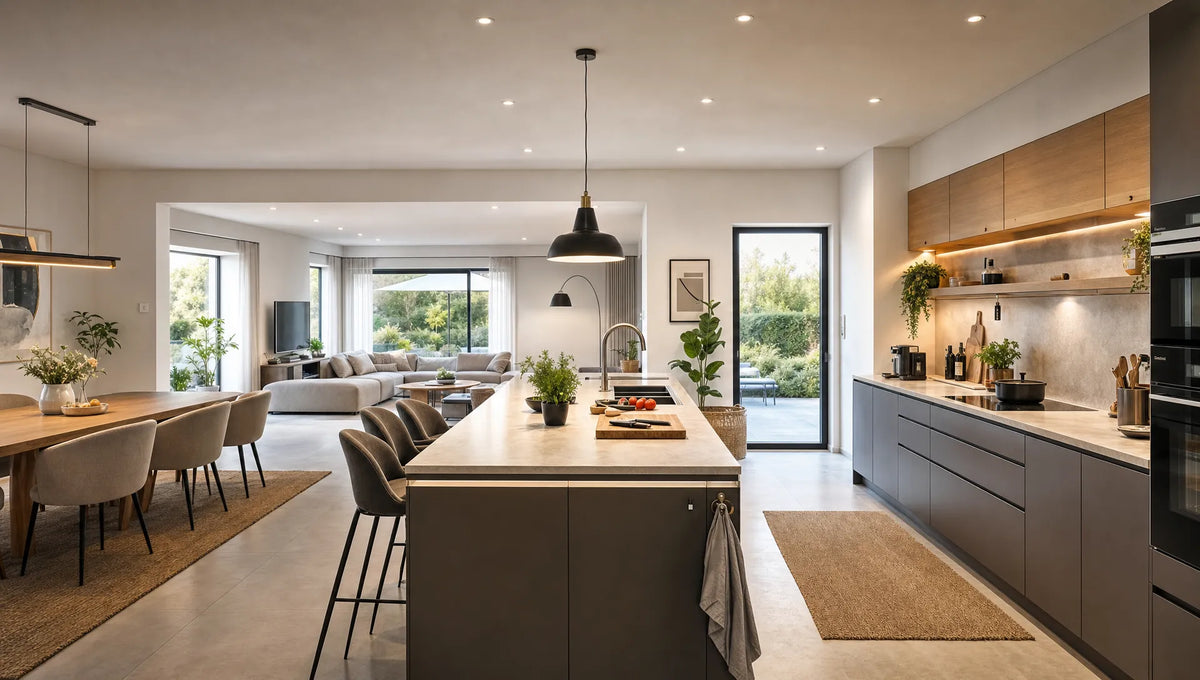
Height-adjustable kitchen lamp glare-free above the island
A kitchen island is rarely just a work surface. It is a cutting room, breakfast bar, meeting point, storage area and sometimes even a home office for a quick conversation in between. That's exactly why the light above has to do more than just look good: it should illuminate the area clearly, make faces look pleasant and not blind you when you're cooking or sitting.
One height-adjustable kitchen lamp is particularly practical because it can be adapted to different uses. But it's not just the adjustability that's important. Freedom from glare is achieved through the interaction of height, light emission, shade shape, light source, surface of the island and position in the room.
Why glare-free is so important above the kitchen island
Above the dining table, glare primarily disrupts the atmosphere. Something else is added above the kitchen island: you work with knives, hot pots, shiny fittings and often with bright worktops. If light falls directly into the eye or is reflected on stone, ceramic, glass or polished quartz, the island becomes uncomfortably bright, even though the actual work surface may not be optimally lit.
Glare usually occurs in three ways. The light source is directly visible, the lamp is hanging too low in the field of vision or the worktop reflects the light too strongly. With open kitchen-living rooms there is another point: Anyone sitting on the sofa or at the dining table often looks sideways at the pendant light. A lamp that looks pleasant when cooking can be blinding from this perspective.
That's why it's worth not looking at the kitchen island in isolation. Always check which directions you can see the light from: standing at the island, sitting on bar stools, from the dining table, from the living room and from the entrance to the room.
The right height: adjustable, but with a clear target zone
The following applies as a practical guideline: The lower edge of the lamp should usually be approx 70 to 90 cm above the worktop hang. For very tall people, particularly low umbrellas or an island with seating, a slightly higher position may be more comfortable. In the case of compact lights with well-shielded light, however, it can be moved closer to the surface.
It is important that the lamp does not hang at eye level. If a person is standing at the island, they should avoid looking directly into the lamp. If you sit on a bar stool, your viewing height changes. This is exactly where a height-adjustable solution comes into its own: you can set the lamp lower for concentrated kitchen work and position it higher for guests, conversations or a quieter evening atmosphere.
| Use of the kitchen island | Recommended orientation | What you should pay attention to |
|---|---|---|
| Cutting, cooking, preparing | approx. 70 to 85 cm above the worktop | Light must reach the hands without creating shadows in front of the body |
| Island with bar stools | approx. 80 to 95 cm above the worktop | Luminaires must not dazzle seated people at eye level |
| Open kitchen/living room | rather upper half of the range | Check lateral lines of sight from the living and dining areas |
| Very high ceiling | depending on proportion and shape of the lamp | Plan the length of the cable or rope to suit the height of the room |
These values are not a hard and fast rule. A flat linear lamp behaves differently than a deep shade, an opal glass body behaves differently than an open metal reflector. It is therefore best to test the height with a second person: one person holds the lamp or a cardboard model over the island, the other checks the visibility, shadows and effect from several positions.
If you would like to take a deeper look at adjustable pendant lights in everyday life, you can find the guide to sensible use of a height-adjustable pendant light further practical application scenarios for the kitchen, dining area and living room.
What makes a kitchen lamp really glare-free
Freedom from glare begins with the light exit. A light can be beautifully designed and still seem unsuitable for the kitchen island if the light source is clearly visible. Shades, diffusers or lamp bodies that guide the light softly and shield the light source from typical viewing angles are better.
Opal glasses, satin diffusers, downward-shielded shades or lights with recessed LEDs are particularly pleasant. Dark interior surfaces can also help reduce harsh reflections, but they absorb more light. Light-colored interior surfaces reflect more light downwards, but can appear brighter in the field of vision if the height is incorrect.
Also pay attention to the beam angle. A very narrow beam of light creates strong accents, but can create bright spots and dark spaces on a long island. A light outlet that is too wide distributes the light softly, but can scatter it more strongly into the room. A balanced mix is usually ideal for the kitchen island: enough directed light for the work surface, but not so harsh that knives, fittings and stone countertops reflect.
The surface of the island also counts. Matt fronts and matt worktops are more forgiving. High-gloss panels, polished natural stone, stainless steel or glass back panels show any unfavorable reflection. In such kitchens, diffuse light emission is particularly recommended.
Choose the light color, brightness and dimmability sensibly
A kitchen needs functional light, but should not look like a work space in an open floor plan. For many kitchen-living rooms, warm white to neutral white light is in the range of approx 2700 to 3000 Kelvin pleasant. If you cook very objectively or have a minimalist, cooler kitchen, you can also consider 3500 Kelvin. In living areas, the technology quickly appears significantly cooler.
For color rendering, it is worth taking a look at the CRI or Ra value. A value of at least 80 is common; food, wood, stone and skin tones usually have a higher quality and more natural effect CRI 90 or higher. This makes a visible difference, especially over an island where cooking and serving takes place.
Dimming almost always makes sense. The island can be brighter during the day or when preparing. In the evening, when the kitchen merges into the living area, a reduced light level is often sufficient. It is important that the light, LED driver and dimmer fit together. If you are planning a dimmable solution, this compatibility should be clarified before purchase.

A lamp or several pendants over the island?
The right number depends on the length and width of the kitchen island, the shape of the lamp and the desired effect. A single pendant light can look very serene over a small island. On longer islands, two or three points of light often appear more balanced. Linear pendant lights are particularly suitable if the island needs to be illuminated clearly and evenly along its length.
If there are several pendulums, the distance is crucial. The light points should neither move too close together nor extend to the ends of the island. As a guide, there is a little space left at both ends so that the lights visually belong to the island and do not protrude beyond it.
| Island length | Often the right solution | Planning note |
|---|---|---|
| up to approx. 120 cm | 1 pendant light or compact linear light | Emphasize the center of the island |
| approx. 120 to 200 cm | 2 pendant lights or longer linear light | Check for even illumination without hard gaps |
| approx. 200 to 280 cm | 3 pendant lights or linear model | Carefully plan the distances between the light points |
| over approx. 280 cm | Multi-flame or modular solution | Pay attention to the proportions of the room size and island width |
If you work with multiple light points, the contribution to three-bulb height-adjustable pendant light a helpful addition because it takes a closer look at distances, widths and typical planning errors.
The power connection is rarely perfect
In new buildings, the outlet can usually be planned to match the island. However, in existing kitchens, renovations or open-plan living spaces, the ceiling outlet is often in the wrong place. Then a solution with a suitable canopy, offset suspension or individually coordinated cable routing is worthwhile.
Especially with height-adjustable lights, the cable length is more than just a technical detail. Suspensions that are too short make the lamp disproportionate, cables that are too long appear unsteady or have to be shortened unsightly. At BUYnBLUE Chandeliers and pendant lights can be adjusted free of charge, for example in terms of cable length, canopy or color. This is particularly helpful if the ceiling height, island position or room layout are non-standard.
Don't just measure the ceiling height before ordering. The height of the worktop, the desired lower edge of the lamp and whether the lamp should hang over the middle of the island or slightly towards the side of the seat are also crucial. For islands with a hob, you should also check whether the extractor hood, hood or downlight fan influence the position.
Design: The lamp should fit the island and the room
A kitchen island is often the central piece of furniture in an open living area. The light above automatically becomes part of the architecture. It can be noticeable, but should not block the lines of sight. Particularly on long islands, delicate shapes often appear lighter than solid umbrellas.
Clear lines, restrained colors and reduced materials work well in minimalist kitchens. In warm kitchen-living rooms with wood, natural stone or beige tones, the lamp can appear softer and more handcrafted. A good example of a modern, light accent is the Pendant Lamp Corda, whose design with ropes and minimalist LED design goes particularly well with calm, contemporary kitchen and living concepts.
What remains important, however, is that design must not displace visual comfort. For each lamp, ask yourself whether it looks pleasant from sitting height and from the living area. A spectacular lamp that dazzles every day will rarely last long.
Planning steps before purchasing
Before you choose a height-adjustable kitchen lamp, it's worth taking a short but precise inventory. Many bad purchases are not caused by bad taste, but by missing dimensions.
- Measure the length, width and height of the kitchen island.
- Note the ceiling height and the location of the electrical outlet.
- Check whether the island is primarily used for working, eating, or both.
- Consider the lines of sight from the living room, dining area and entrance.
- Decide whether you prefer a single light, several pendants or a linear solution.
- Clarify whether dimmability, individual cable length or an adapted canopy are necessary.
Another tip: Photograph the kitchen from multiple angles during the day and evening. Photos often make it easier to see whether a light would be too dominant, whether the island needs more length or whether a dark corner needs additional basic lighting.
Common mistakes with kitchen lights over the island
The most common mistake is a lamp that is hung too low and has a visible bulb. It seems homely at first, but becomes disruptive in everyday life. Another problem is a lamp that only shines downwards but illuminates the work surface unevenly. Especially with long islands, bright islands of light and dark spaces arise.
The wrong size is also quickly noticeable. A very small lamp over a wide island looks lost. A light that is too large can visually weigh down the room and disrupt the view between the kitchen and living area. In open kitchens, the kitchen lamp should also harmonize with the lighting above the dining table. If your island is directly adjacent to the dining area, the guide can be used glare-free Pendant Lamp above the dining table help to coordinate both areas harmoniously.
An underestimated point is the basic lighting. A pendant light above the island does not automatically replace ceiling lights, under-cabinet lights or indirect light. Depending on the room, the kitchen needs several lighting zones: work light on the island, light on the main work area, calm ambient light and, if necessary, accent light for shelves or niches.
Frequently asked questions about the height-adjustable kitchen lamp over the island
How high should a kitchen lamp hang above the island? In many kitchens, a lower edge of around 70 to 90 cm above the worktop works well. If you have a seat, are tall or have open lines of sight, a slightly higher position may be more comfortable.
Which type of lamp is the most glare-free over the kitchen island? Lamps with a diffuser, opal glass, shielded shade or recessed light source are usually more pleasant than open lamps. It is crucial that you do not look directly into the light source from typical viewing angles.
Does a height-adjustable kitchen lamp also make sense if the ceiling is low? Yes, if the lamp remains compact and the adjustment does not take up too much space. For low ceilings, a precise cable length is particularly important so that the lamp neither disturbs nor hangs too high.
How many pendant lights do I need over a kitchen island? Small islands often get by with one light. For longer islands, two or three pendants or a linear light usually have a more balanced effect. The lights should match the length of the island and provide even light.
Which light color suits the kitchen island? For open-plan kitchens, around 2700 to 3000 Kelvin is often pleasant. If you prefer a more objective working atmosphere, you can plan something more neutral. Dimmability helps to combine work light and evening atmosphere.
Conclusion: Glare-free means better planning, not less light
A good kitchen island needs light that is precise enough for working and soft enough for living. A height-adjustable kitchen lamp offers a lot of scope for this if the height, shade, light color, dimmability and position work carefully together.
At BUYnBLUE Find curated designer lights for modern living spaces, with high-quality materials, free worldwide shipping and a 14-day return policy. Particularly practical for kitchen islands: pendant lights and chandeliers can be adjusted free of charge, for example in terms of length, canopy or color, so that the light really matches the ceiling height, island dimensions and room layout.


